

/https%3A%2F%2Fcdn-tor.buminteractif.com%2F2026%2F04%2F20190244%2FGettyImages-2269816920.jpg)
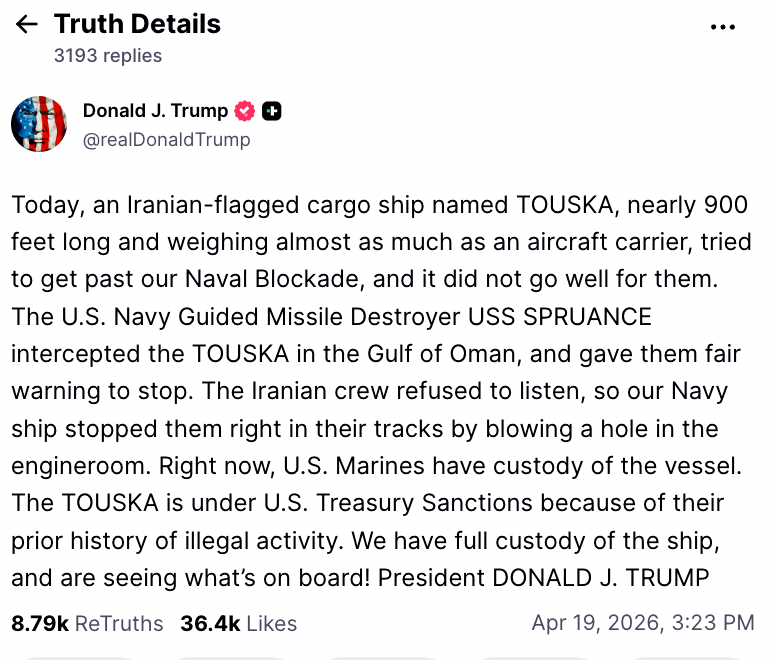
According to a video released by the US government and a social media post by Donald Trump, the US has seized an Iranian vessel as part of its new blockade imposed on the Strait of Hormuz. According to Trump, the 900-foot vessel Touska, weighing nearly as much as an aircraft carrier, attempted to bypass the US military's blockade on April 19th. The US military warned the vessel to stop, and after the Iranian crew refused, US forces blew a hole in its engine room before taking possession of the vessel. A video was released by the US military, showing a US vessel firing a gun at another ship in the distance. The video also showed helicopters surrounding the vessel and US troops boarding the cargo ship.
Strait of Hormuz standoff
As of April 20, the US and Iran are engaging in a large-scale Western standoff surrounding the Strait of Hormuz. The small waterway that transports a fifth of the world's oil has been a key pillar of Trump's war on Iran. Earlier in April, Iran had created a blockade in the strait, firing on vessels attempting to pass through in hopes of affecting oil prices in the Western hemisphere. The US responded by creating a blockade of its own with fleets of ships targeting vessels leaving Iranian ports. Iran announced that it would lift its blockade on April 17, but reversed its decision on April 19, firing on multiple vessels passing through the waterway.
Now, both the US and Iran have a blockade affecting traffic through the Strait, and oil prices will continue to suffer. Since the start of the war, the price of global crude has risen nearly 50 per cent, with American gas prices rising $1.30/gallon, and Canadian gas prices rising 30 cents a litre. Americans are feeling the effects of Trump's war, and the ripples are creating waves in any country that relies on oil imports. Now, electric vehicle sales are skyrocketing in European markets, and with Canada and the US committing to EV factories, Trump's war on Iran is beginning to define the auto industry as a whole.
Iran-US ceasefire
On April 8, the US government announced a two-week ceasefire had been agreed upon with Iran, avoiding a potential US ground invasion. Leading up to the ceasefire agreement, President Trump had promised Iran that ‘a whole civilization will die tonight' during a speech on April 7, directly threatening Iranian civilians with the comment. Iranian officials signed a ceasefire agreement just hours later. The two-week ceasefire, which was mediated by Pakistan, was reluctantly signed by Iran. Iranian officials were pushing for a more permanent peace agreement, but the US and Pakistan would not concede, instead forcing Iran to settle for a temporary ceasefire. Unfortunately, neither country (nor Israel) has complied with the written agreements in the ceasefire.
Broken ceasefire
Just hours after the ceasefire was signed, Israel struck Lebanon with a flurry of airstrikes, breaking the ceasefire immediately. Israel hit Lebanon with 100 rockets in just ten minutes, sending ten rockets a minute to Beirut's southern suburbs. Both the US and Israel claimed that Lebanon was not a part of the ceasefire, but the mediating Pakistan said it was absolutely included in the agreement. With Israel breaking the ceasefire to target civilians, just hours after it was signed, the agreement was marred with violations from the beginning. In the following hours, Israel continued to break the international treaty, striking Iran twice and continuing to target Lebanon. On April 9, Israel invaded the town of Bint Jbeil in southern Lebanon, creating an all-out battle for the city.
After Israel's attacks on Lebanon, Gulf countries reported drone attacks from Iran, with an Iranian official confirming the strikes and citing Israel's continued barrage on Lebanon. Iran's promise to leave the Strait of Hormuz alone during the ceasefire was quickly broken as well, with few ships successfully passing through the waterway. Experts confirmed that on April 9, the Strait was still effectively closed to cargo vessels. On April 13, the US imposed its own blockade on the Strait, furthering the ceasefire's irrelevance to the conflict. Now, the US has seized an Iranian-flagged cargo ship in the Gulf of Oman, an action that certainly goes against the ceasefire agreement.
War on Iran
On February 28, 2026, the US government and Israel undertook a joint operation in Iran, with the US subsequently declaring it was at war with the country. The attacks triggered retaliatory strikes from Iran, targeting US and Israeli military bases across the Middle East. According to Donald Trump, there is no timeline for this war, and the US will continue its operations in the country until it sees a significant regime change, as well as an end to Iran's supposed nuclear program.
US and Israeli strikes killed Iran's Supreme Leader, Ali Khamenei, on Day One of the war, completing Trump's supposed goal. Khamenei has been using deadly violence against civilian protesters in Tehran, and his killing has been the only positive piece of Donald Trump's illegal intervention.
Donald Trump changed his reasoning for attacking Iran after Khamenei's death, instead claiming he attacked Iran because he had certain information that Iran was going to attack Israel and the United States. Israel calls the strategy ‘forward defence'. Now, after 51 days of war, both Iran and the US continue to posture and are engaging in a standoff surrounding the Strait of Hormuz. Donald Trump needs to alleviate pressure on oil markets in order to further commit financially to the War, and Iran is trying to balance its own exports while putting pressure on the West.
The result has been overwhelmingly negative for all civilians involved.
Created by humans, assisted by AI.
