

/https%3A%2F%2Fcdn-tor.buminteractif.com%2F2026%2F05%2F04192356%2FGettyImages-2273905602.jpg)
On May 4, Mark Carney became the first non-European representative to address the biannual EPC summit, which this year was held in Armenia. In his five-minute address to the conference, he maintained that Canada is ‘the most European of the non-European countries', citing a strong European immigrant population and Canada's bilingualism as reasons why. Canada is the first non-European country to be invited to the EPC summit, showcasing that Carney's goal of strengthening ties with Europe has been a success up to now. Carney boasted how Canada has supported EU initiatives, and that Canada is the only EU country to invest in certain initiatives, like EU SAFE. Carney also stressed that Canada is an energy superpower as one of the global leaders in oil production. He did not mention Canada's Uranium-rich deposits.
Carney pledges $270M to Ukraine
During his historical address, Carney also stressed that Canada has been one of Ukraine's strongest financial allies, committing more than $25 billion to the country since 2022. Carney clarified that the money would be used to buy weapons and munitions from the US, drawing some criticism. Canada's consistent aid to Ukraine has created a rift amongst Canadian voters, with many believing the hefty $25 billion price tag is too steep. Carney stressed that the reason Canada was at the summit was because of the “immense potential” for partnerships with Europe. Carney also stressed that the world cannot look at the economy through nostalgic glasses, and that the world needs to be realistic regarding Donald Trump's threats, and the unrest caused by Russia, the US, and Israel's wars.
“We have to actively take on the world as it is, not as we wish it to be. We know nostalgia is not a strategy, but we don't think that we're destined to submit to a more transactional, insular and brutal world.
-Mark Carney
Carney said it was his strong personal view that international order can and will be rebuilt through Europe. This is consistent with Carney's messages emboldening what he calls ‘middle-powers'. Middle powers are countries with strong sovereign power and significant exports, but whose GDP does not classify them as a ‘global superpower'. Examples of these nations include Canada, Australia, Japan, Mexico, Brazil, and the Scandinavian countries. Of the 193 countries in the world, about two dozen are classified as ‘middle powers'. Carney spent a significant amount of time meeting with ‘middle powers' on May 3 and 4. Before his address on May 4, Carney met with European Commission President Ursula von der Leyen and Antonio Costa, president of the European Council. According to the Prime Minister's Office, the leaders discussed deepening collaboration in areas such as supply chains, critical minerals, energy and technologies. Carney also had meetings with Italian Prime Minister Giorgia Meloni and Spanish Prime Minister Pedro Sanchez on May 4.
What happened at the meetings?
On May 3, Mark Carney met with a plethora of world leaders and important figures. It began with a meeting with the president of the European Parliament, Roberta Metsola. Metsola revealed that she had sent the invitation to Carney multiple weeks before the summit, and was ‘very pleased' that the Canadian PM could attend. Carney also met with more of his much-loved middle powers on May 3. Carney met with Armenian Prime Minister Nikol Pashinyan, whose country is hosting the event. Carney also met with Polish Prime Minister Donald Tusk, among others. According to reports from CBC and CTV News, US President Donald Trump loomed largely over those discussions. It's highly unlikely that Mark Carney would have been invited to the EPC summit without Donald Trump's sweeping tariffs endangering global supply chains. Trump recently accused the EU of breaking the terms of its trade agreement with the United States. As a result, he said, he promised to increase his tariffs on auto imports from EU countries.
Pierre Poilievre criticizes Carney
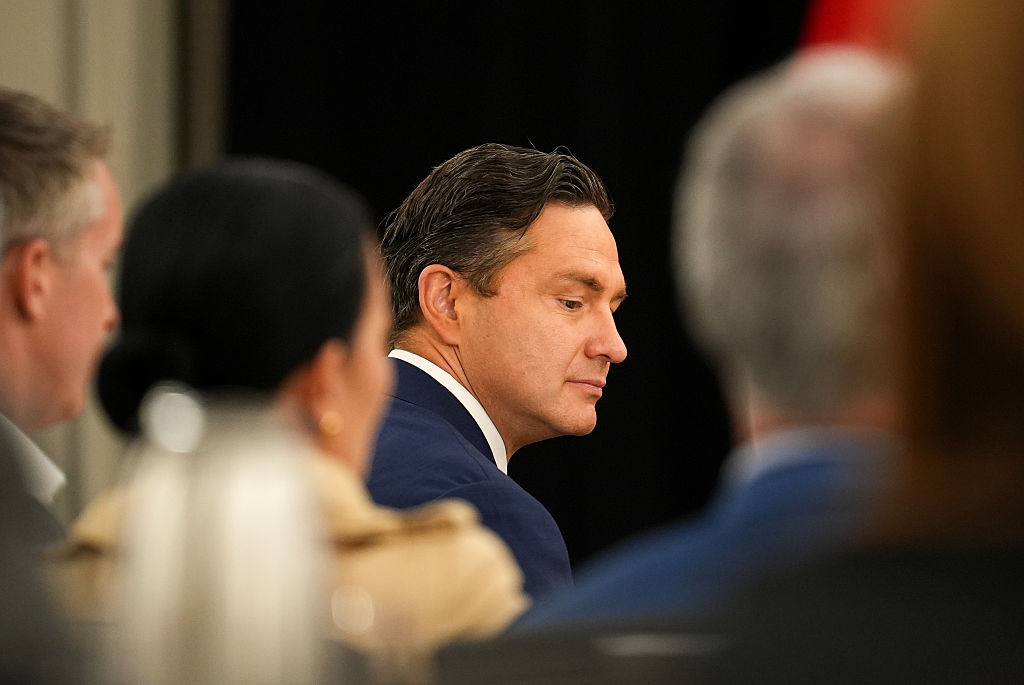
Conservative Party leader Pierre Poilievre, who is fresh from blowing one of the largest leads in Canadian political history, spoke with the media in Toronto on May 3. According to CPC leader Poilievre, who lost his own seat in Parliament during the 2025 election, the trip was a waste of resources that will only serve to cost taxpayers more money.
“[The EPC summit] is another trip, signing fake MOUs and giving dazzling speeches all while delivering no real results here at home.”
-Pierre Poilievre
An MOU is a Memorandum of Understanding, a formal, but non-legal document between two parties outlining an agreement to cooperate on a mutual goal. Carney has signed multiple MoUs, including some within Canada, like his agreement with Alberta Premier Danielle Smith regarding the new bitumen pipeline. While Poilievre is absolutely correct in pointing out that these documents are not legally binding, there is no proof showing that the documents are ‘fake'. In fact, Carney has received glowing reviews from the international market for his dedication to relationship-building.
Poilievre also criticized Carney's constant travel. Armenia is the 21st country Carney has visited since his election as the PM, focusing on creating new trade agreements and new partnerships amidst the collapsed relationship between the US and Canada. During his first year in office, Mark Carney has made European partnerships the main focus of his administration. While campaign promises like ‘Build Canada Homes' and ‘Nation-building projects' have taken a backseat, Carney has secured 20 partnerships with European countries over his first year in office.
