

/https%3A%2F%2Fcdn-tor.buminteractif.com%2F2026%2F06%2F15181233%2FGettyImages-2280930382.jpg)
Canadian Prime Minister Mark Carney has claimed the world is entering a new era where countries can no longer rely on a single superpower, institution or alliance to solve every major challenge. Speaking ahead of this week's G7 summit in France, Carney argued that governments must build flexible partnerships around shared interests rather than depend on traditional geopolitical structures. His comments come as Canada deepens ties with countries such as Ireland on issues ranging from artificial intelligence and biotechnology to food security, reflecting what appears to be an emerging foreign policy strategy focused on building networks of like-minded middle powers in an increasingly fragmented world order.
Carney making deals with Ireland
Carney made the remarks during a visit to Ireland, where he met with Taoiseach Micheál Martin before travelling to the G7 summit. The prime minister suggested that the international system that dominated much of the post-Cold War era is giving way to something more decentralized. Carney expressed the growing concern among Western governments about geopolitical instability, economic competition and technological disruption. Carney arrived in Ireland on June 13 with the purpose of growing his network of ‘middle powers' countries with strong GDP and capable economies.
What one can't do at this point in a rapidly shifting world order is to rely on one set of institutions, one grouping, one country to provide the answers,
-Mark Carney
Following meetings between the two leaders, Canada and Ireland announced plans to expand cooperation in artificial intelligence, biotechnology, pharmaceuticals and food security. Carney described the visit as an opportunity to strengthen an already growing relationship between the two countries. Both governments have recently released national artificial intelligence strategies and see opportunities to collaborate on research, innovation and workforce development. Officials also announced plans to expand cooperation in life sciences, including support for researchers and students working in sectors expected to play an increasingly important role in future economic growth.
You have to know what you want, what you need, how you serve your citizens, and then go out and get it.
-Mark Carney
Growing his ‘middle power' allies
With his focus on moving away from US reliance, Carney has been heralding the strength that middle powers can have by working together. Rather than looking for a single replacement for the existing international order, Carney has increasingly emphasized what he calls “ad-hoc coalitions”. Ad-hoc coalitions would involve groups of countries working together on specific issues where their interests align. The approach acknowledges that governments may agree on some priorities while disagreeing on others. Carney pointed to issues such as artificial intelligence and online safety as examples where countries may choose different paths. Some governments favour stronger regulation while others take a more hands-off approach. Under that model, Canada would pursue partnerships issue by issue, seeking allies wherever common interests exist rather than relying exclusively on traditional diplomatic blocs.
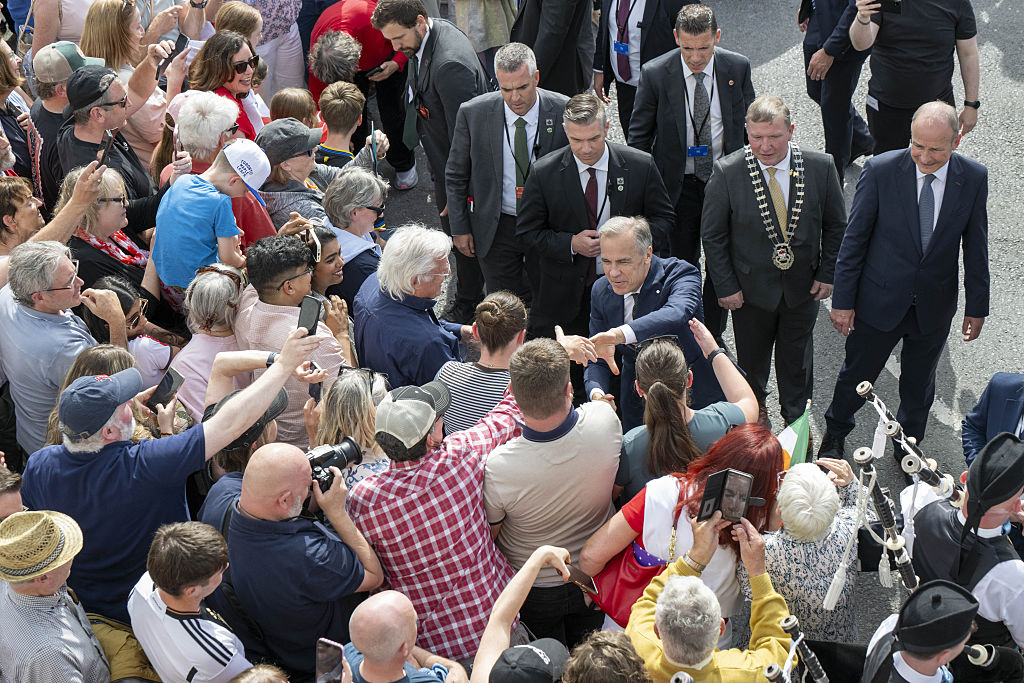
Carney is attempting to position Canada as a bridge between Europe and North America at a time when many governments are reconsidering longstanding assumptions about trade and security relationships. During his visit to Ireland, he argued that countries should not compete with one another for favour from the United States. Instead, he suggested that Canada and European partners can work together to advance shared interests while maintaining constructive relationships with Washington. Ottawa is making serious efforts to diversify economic and diplomatic partnerships without abandoning traditional alliances.
Whether that vision succeeds may become clearer at the G7 summit. Carney has suggested the gathering could help weave together some of the “strands” of a new world order. Yet his comments in Ireland indicate that he does not expect any single summit, institution or alliance to define what comes next. Instead, Canada appears to be betting that the future will belong to countries capable of building flexible partnerships around technology, food security, economic resilience and shared democratic values. The agreement with Ireland offers an early example of what that strategy may look like in practice. With Carney's speech at Davos creating international waves, the Canadian prime minister will be looking for another effective international summit to reaffirm his message.
