

/https%3A%2F%2Fcdn-tor.buminteractif.com%2F2026%2F09%2F05174103%2FGettyImages-2270722912.jpg)
The Conservative Party has taken yet another hit at the hands of the Liberals, with the Liberals sweeping all three byelections held on September 1st, 2026. In Quebec's riding of Chicoutimi—Le Fjord, the Conservatives took their biggest loss of the byelection, with Conservative candidate Régis Gaudreault only managing a measly 12.6 per cent of the vote. This loss marks yet another piece of evidence that Quebec, and Canada as a whole, is moving away from the Conservative Party after Pierre Poilievre's legendary bungling of the 2025 Federal Election. Liberal Party member Daniel Gobeil took home the win with just under 52 per cent of the vote, while Bloc Québécois' Caroline Dubé managed 32.8 per cent.
“[Gobeil] will be a strong voice for rural Quebec and the entire agri-food sector across the country”
-Mark Carney
We should set the scene here. Conservative politics in Canada have changed drastically over the last 16 months. In April 2025, Pierre Poilievre's Federal Conservatives held a massive 20-point lead over the helmless Liberals after Justin Trudeau stepped aside amid a tenure marred by political infighting. It seemed as though the Federal election would be a slam-dunk for the Conservatives. Pierre Poilievre was at the height of his popularity to start 2025, and with Trudeau's popularity numbers in the toilet, it was Poilievre's race to lose.
The hits keep coming
Lose he did, failing to garner Canadians' support in the months leading up to the election. Poilievre's style of ‘mini-Trump politics' had created unrest in the country, and Canada was swinging towards the right with confidence, right up until Donald Trump threatened to invade the country. Poilievre, who had long been using the comparisons between him and Trump to his advantage, was now faced with a country that near-unanimously hated the American president. Mini-Trump politics weren't going to work for Poilievre, not after Trump had threatened the country.
Now, that trend is bleeding into Provincial politics. During the 2025 Federal election, Quebec flipped 12 seats that were previously held by the Bloc Québécois. While the Bloc is, of course, not the CPC, it's a party that holds more traditional conservative values. The CPC only managed 11 seats in Quebec during the election, a far cry from what they expected. The CPC expected to gain seats from both the Bloc and the Liberals, but instead lost a seat to the Bloc and gained none from either the Liberals or the BC.
Chicoutimi—Le Fjord Candidates
The three major candidates in Chicoutimi—Le Fjord were Daniel Gobeil representing the Liberal Party, Caroline Dubé from the Bloc, and Régis Gaudreault from the Conservative Party of Quebec. Gaudreault, a professor at Cégep de Chicoutimi and a career lawyer with his own firm, reportedly entered the race confidently (though nobody is sure why; the last MP to hold the seat was a Conservative, and none of the preliminary polls suggested Gaudreault would win). Gaudreault denied preliminary interviews with CBC and TVA in July and instead relied on controlled messaging through scheduled press conferences. Gaudreault, who operated his own legal practice for more than 40 years, ran on an extremely traditional platform. Apparently, Gaudreault hasn't seen the direction the last election went, and instead of changing things up, he advertised the long-standing promises to lower taxes and improve the economy. Of course, he didn't say how he would lower taxes and improve the economy, but traditionally, Conservatives haven't given the hows anyway.
Although Gaudreault was publicly confident, early polls showed the riding would be a two-party race between the Liberal Party and the Bloc.
Bloc Québécois' Sovereignty platform suffering
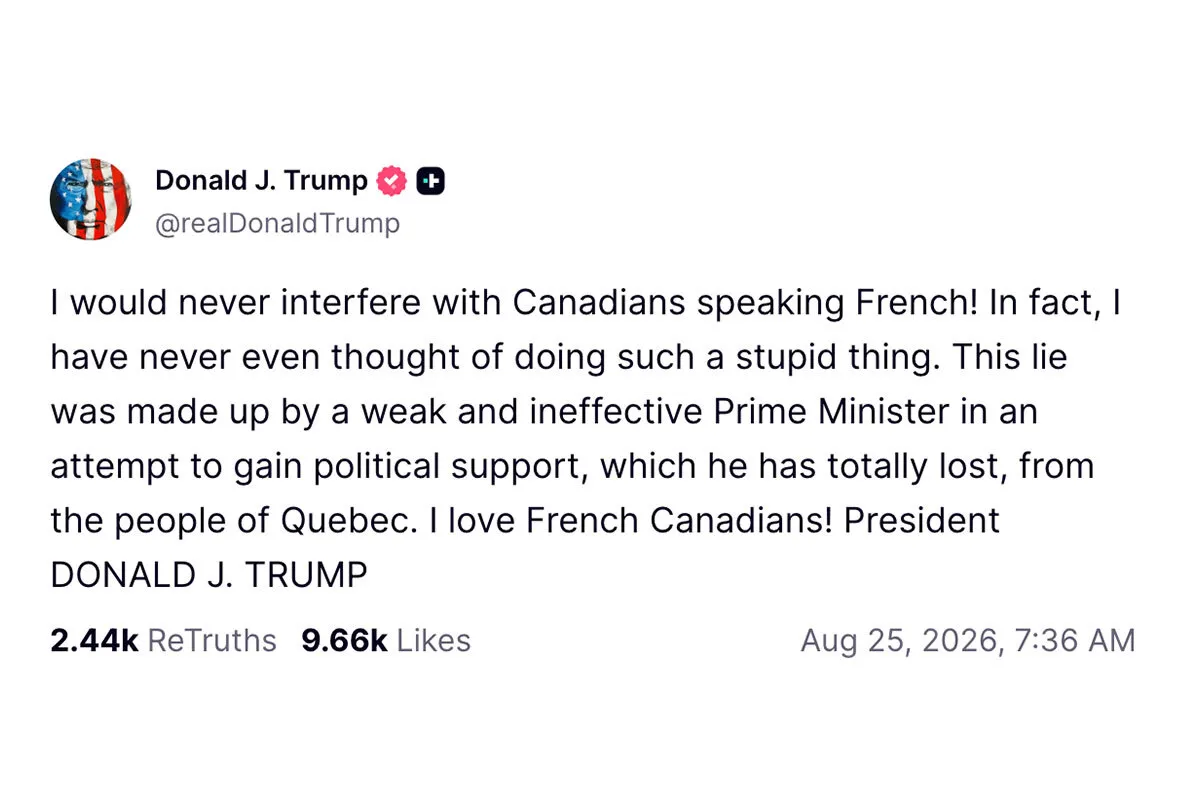
While the Bloc were confident (with better reason), this loss is another disappointment that can almost certainly be attributed to Donald Trump's trade war with Canada. The Bloc's insistence on vying for Quebec separatism and French sovereignty has taken a serious hit since Donald Trump took power. The American President has been very vocal about his distaste for Canada, and French Canada specifically. In late August, reports emerged that Donald Trump was pressuring Canadian PM Mark Carney to crack down on French-language laws in Canada and Quebec. Both Carney and Quebec Premier Christine Fréchette have said that U.S. negotiators sought last-minute concessions regarding language. According to Carney and Fréchette, Donald Trump attempted to target longstanding laws that promote French-language cultural content and require that the language be included on packaging and in instruction manuals.
Of course, Donald Trump denied this on Truth Social, but for Canadians, it's easier to trust Mark Carney and Fréchette than the man in the Oval Office.
“I would never interfere with Canadians speaking French – I love French Canadians!”
-Donald Trump via TruthSocial
These reports came out just days before the by-election, and the Bloc suffered for it. With Donald Trump acting as a source of chaos in the Canadian economy, the timing for French sovereignty has never been worse. Mark Carney's ‘United Canada' has never been more important, and residents of Quebec know that even though they're Province has the capability to be sovereign, it's seriously advantageous to remain a part of the country. Even Bloc Québécois candidate Caroline Dubé took her foot off the separatist gas pedal. Instead of speaking about separatism, she focused on campaigning for an economy capable of sovereignty. Dubé emphasized the importance of developing a phosphate industry using the Port of Saguenay, and she spoke at length about the impact of Donald Trump's tariffs on the aluminum and forestry sectors present in the region of Chicoutimi—Le Fjord.
Dubé campaigned on an anti-Liberal platform rather than an anti-Canada one, using the French language as a building block. Dubé tried to paint the Liberals as ‘anti-French', and used Mark Carney as an example, claiming that his party was failing to properly protect French Canadians in negotiations with Donald Trump. Unfortunately for Dubé, those comments came just days before Mark Carney stepped away from negotiations with Trump, citing the French-language concessions as one reason. Carney publicly stated that French was absolutely not on the negotiating table and cited it as one of the major reasons he stepped away from the long-term negotiations.
With trade negotiations between Canada and the US stalled, Quebec politics, specifically the Bloc Québécois' platform, will continue to be tainted. Separatism has been, and will always be, a significant piece of the puzzle for French-Canadian voters. While Canada continues to battle against tariffs and insults from its most historical ally, separatism has taken a backseat, and the Liberal Party is taking full advantage.
